SOC 2 Mapping to ISO 27001: A Practical Crosswalk
SOC 2 Mapping to ISO 27001. Learn how to map SOC 2 to ISO 27001 with a practical crosswalk covering equivalencies, gaps, and unified compliance program
You've gathered access reviews, change approvals, and incident records for a SOC 2 examination. Then a customer asks for ISO 27001 certification, and leadership asks whether you can reuse everything. Your engineering team wants to know whether this means another set of security processes.
SOC 2 mapping to ISO 27001 should help you build a shared control program, not duplicate it. The difficult part isn't drawing relationships between requirements. It's deciding which evidence transfers, what context each auditor needs, and who owns the remaining work.
Why SOC 2 and ISO 27001 Are Not Interchangeable
Consider a security team that already reviews privileged access. The reviewer checks account permissions, records exceptions, and tracks removals. That activity may support both frameworks, but attaching another framework label doesn't establish that the review covers the right systems, addresses the relevant risks, or has enough supporting evidence.
SOC 2 is an attestation framework; ISO 27001 specifies requirements for an information security management system, or ISMS. SOC 2 evaluates whether controls provide reasonable assurance against selected, outcome-based Trust Services Criteria. ISO 27001 requires an organization to establish, implement, maintain, and continually improve a risk-based ISMS, as distinguished in the AICPA Trust Services Criteria and framework-mapping resources.
| Comparison | SOC 2 | ISO 27001 |
|---|---|---|
| Primary focus | Controls supporting selected Trust Services Criteria | Conformity of a risk-based ISMS |
| Starting point | System commitments, requirements, and risks | ISMS scope, risk assessment, and treatment |
| Assurance outcome | Independent examination and report | Certification through an accredited process |
| Mapping implication | Explain how the activity addresses the selected criteria | Explain its role within the management system |
Start with the assurance boundary
Before reusing that privileged-access review, ask which accounts it covers. Does it include production administrators, deployment automation, and agent service identities? Does the ISO scope include systems outside the SOC 2 system description?
Those are scoping questions, not spreadsheet questions. My recommendation is to record the boundary before assigning either framework reference. Otherwise, a technically correct mapping can conceal an incomplete implementation.
The outcome-based nature of SOC 2 also matters. Organizations don't have to implement identical controls, so copying another company's crosswalk won't establish whether your own activities address your commitments.
Practical rule: Map the control you actually operate, not the policy title you wish described it.
A control can support multiple requirements without producing either assurance outcome automatically. Treat the crosswalk as a documented argument: this activity, performed by this owner, within this boundary, addresses these objectives. The auditor still evaluates that argument and its evidence.
Understanding the Framework Structures
Category-name matching is a weak foundation for a crosswalk. A broad assurance category and an operational control theme describe different levels of detail.
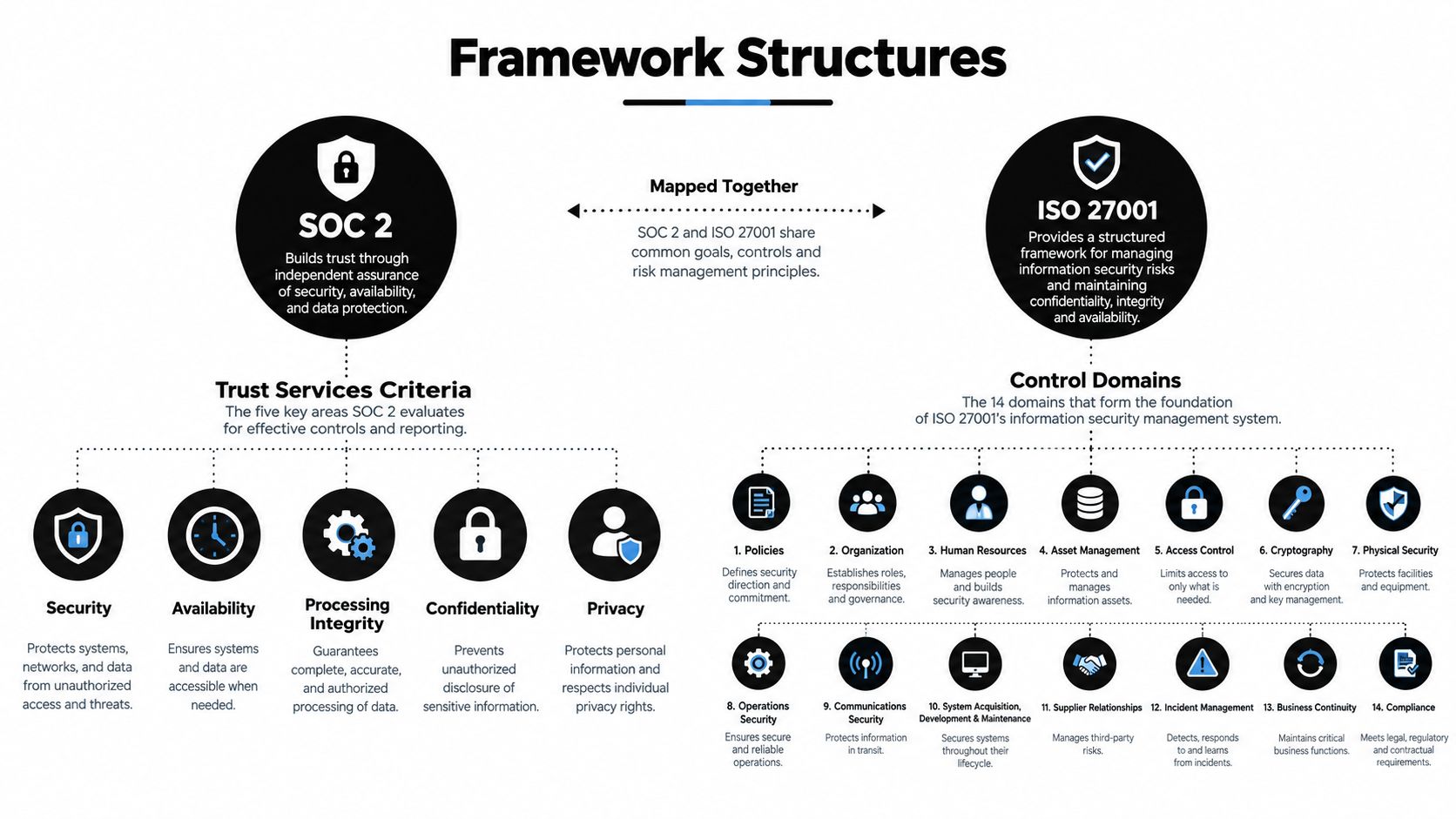
SOC 2 organizes its criteria under Security, Availability, Processing Integrity, Confidentiality, and Privacy. Security includes 33 Common Criteria; the other categories add 3, 5, 2, and 18 criteria, respectively, according to the SOC 2 and ISO 27001 structural comparison. Those categories aren't equivalent to departments, evidence folders, or implementation checklists.
Use the correct ISO edition
ISO/IEC 27001:2022 was published on October 25, 2022. Its Annex A changed from 114 controls in 14 sections to 93 controls across four themes, Organizational, People, Physical, and Technological, as documented in the Thales ISO/IEC 27001:2022 compliance brief.
The infographic's reference to security control domains reflects the older structure. Use it as a conceptual illustration, not as the authoritative structure for a current mapping.
Map objectives rather than headings
Consolidation changes how a legacy matrix should be interpreted. Several historical rows may now relate to a consolidated control. Retaining every old row as an independent implementation task can create duplicate work, while replacing references can conceal a changed evidence requirement.
Review newer areas explicitly, including threat intelligence, cloud-service security, configuration management, data masking, data leakage prevention, monitoring activities, and secure coding. The revision guidance cited above identifies these as areas requiring attention. Don't assume a broad security-policy reference demonstrates implementation.
For each relationship, ask:
- Objective: What undesirable outcome does the control address?
- Implementation: Which person, system, or workflow performs the activity?
- Evidence: What record would let someone verify it happened?
- Boundary: Which environments, identities, and services are included?
For example, a configuration-management objective could involve repository review, deployment approval, and production settings. Those activities may connect to several framework requirements without sharing a category name.
Your internal control should be the stable mapping anchor. Framework references describe why the control matters; they shouldn't dictate how you organize every engineering workflow.
Control-by-Control Comparison by Objective
Start with an operational question: what must the team demonstrate? For access management, the answer might be that authorized reviewers evaluate permissions and resolve inappropriate access. That's more useful than starting with a framework identifier and searching for a vaguely similar title.
The following is a working classification, not a universal equivalence judgment. Direct means the implementation has a shared objective. Partial means additional scope or context needs examination. Supplemental means the available technical evidence doesn't establish the requirement by itself.
Shared Control Objectives Across SOC 2 and ISO 27001
| Control Area | Coverage | Reusable Evidence |
|---|---|---|
| Access control | Direct intent, subject to scope validation | Access reviews, MFA configuration, provisioning and removal records |
| Change management | Direct intent, with period and population checks | Change tickets, approvals, repository history, configuration checks |
| Incident response | Direct intent, with governance context | Incident records, response actions, follow-up reviews |
| Vendor oversight | Partial until supplier scope and risk decisions align | Due diligence, supplier reviews, remediation tracking |
| Logging and monitoring | Partial until monitored systems and follow-up are established | Monitoring records, investigated alerts, configuration exports |
| Resilience | Partial until recovery commitments and risks align | Backup testing, recovery records, corrective actions |
| Security awareness | Shared activity with scope-dependent coverage | Training logs and completion records |
| ISMS governance | Supplemental management-system evidence | Scope, risk decisions, applicability rationale, audit and review records |
These reusable evidence categories follow the structural comparison cited earlier. The important limitation is that reusable doesn't mean sufficient.
Test the evidence transfer
An access-review export may show which accounts a reviewer inspected. It may not show whether the export included every relevant account, whether the reviewer had authority, or whether identified removals were completed. Keep the underlying record, then identify the missing proof.
For change management, preserve the connection between the approved change and what was deployed. A pull-request approval for an agent tool definition is useful, but it shouldn't stand in for approval of a different configuration running elsewhere.
Vendor oversight deserves particular care. Reusing a supplier questionnaire is sensible. Treating it as evidence that someone accepted the residual risk is not. Recommend a separate, attributable decision record whenever the questionnaire identifies an unresolved issue.
This objective-first approach is also useful when extending a program through SOC 2 and HIPAA mapping. Keep the implementation stable, then evaluate each additional requirement rather than assuming that another framework label closes it.
For ISO readiness, explicitly account for the ISMS scope, information-security risk assessment and treatment plan, Statement of Applicability, internal-audit results, and management-review minutes identified in the structural comparison. Don't classify those deliverables as complete because a technical safeguard exists. Assign an owner to each missing artifact and specify what approval or review will establish completion.
Building a Dual-Evidence Architecture
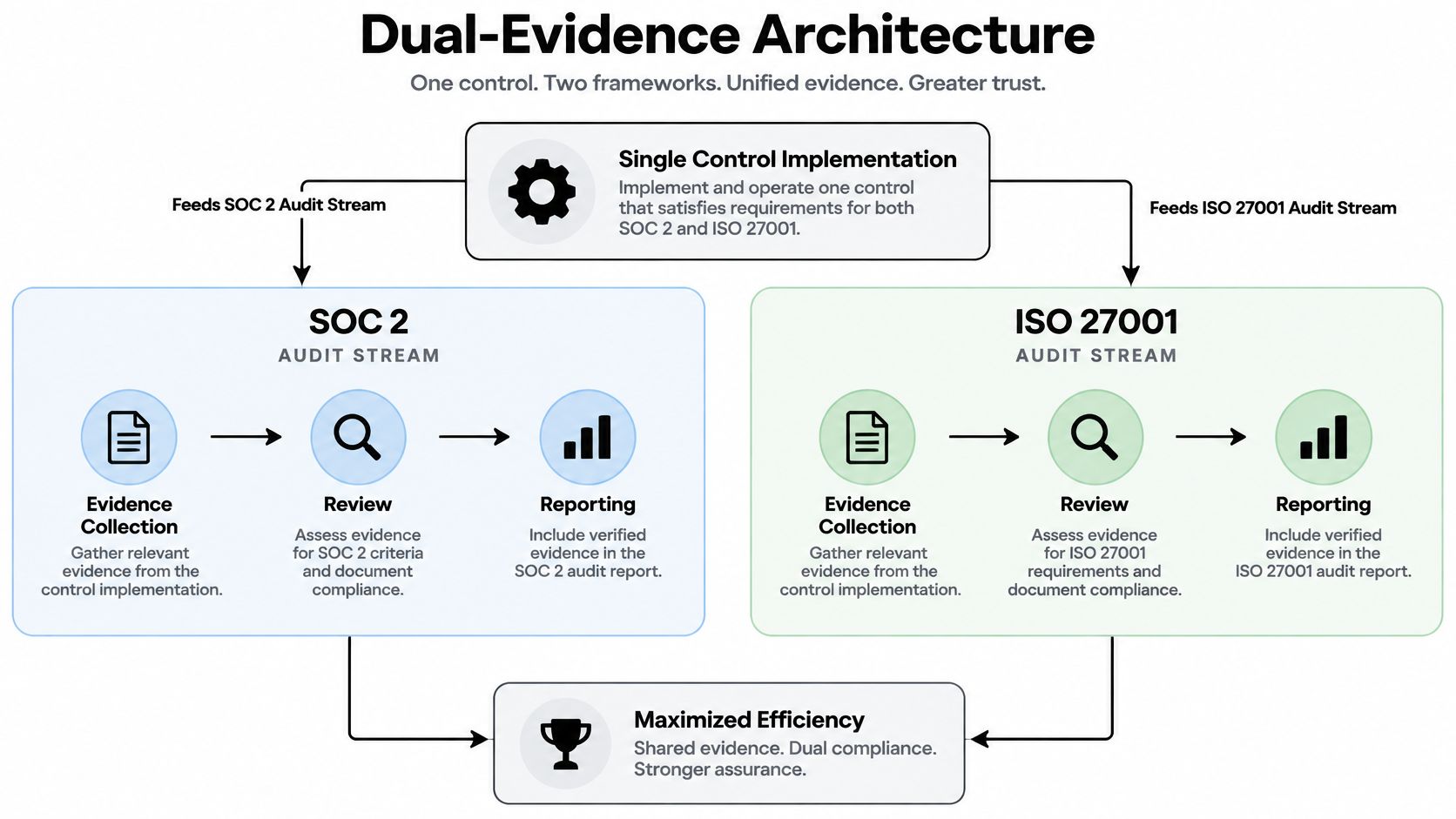
A dual-evidence architecture preserves a shared factual record while supporting different audit interpretations. It doesn't require separate copies of every log or ticket. It requires reliable connections between the original record, the control, and the assurance question.
SOC 2 generally needs control narratives, populations, samples, and operating-period evidence. ISO auditors also need to establish that the activity sits within the ISMS and connects to risk decisions. That distinction underpins the evidence and operating-model discussion in Secure's control-mapping guidance.
Preserve the record and attach its context
Use an immutable or version-preserved evidence object for the underlying event. For a configuration review, retain the analyzed file version, commit SHA, policy version, execution time, and configuration scope. Avoid replacing the original result when someone fixes the issue.
Attach contextual records separately:
- Control ownership: Name the accountable owner and the reviewer.
- Risk linkage: Identify the risk and treatment decision the activity supports.
- Review context: Record the applicable review period and expected cadence.
- Exception handling: Preserve approvals, restrictions, expiry conditions, and remediation status.
Then assemble audit-specific views from those relationships. The SOC 2 view can expose the relevant population and period. The ISO view can connect the same event to the applicability rationale and risk treatment.
Separate snapshots from operational records
A static scan describes an inspected configuration at a particular point. A gateway event describes an observed request within the gateway's supported, routed traffic. Keep these evidence classes separate, even when they support the same control.
Preserve what happened once. Explain what it proves for each engagement separately.
That distinction prevents a clean pre-deployment scan from becoming an unsupported claim about ongoing enforcement. It also lets reviewers trace an exception from the original finding through approval, deployment, monitoring, and closure without rewriting history.
What Shared Controls Do Not Save You
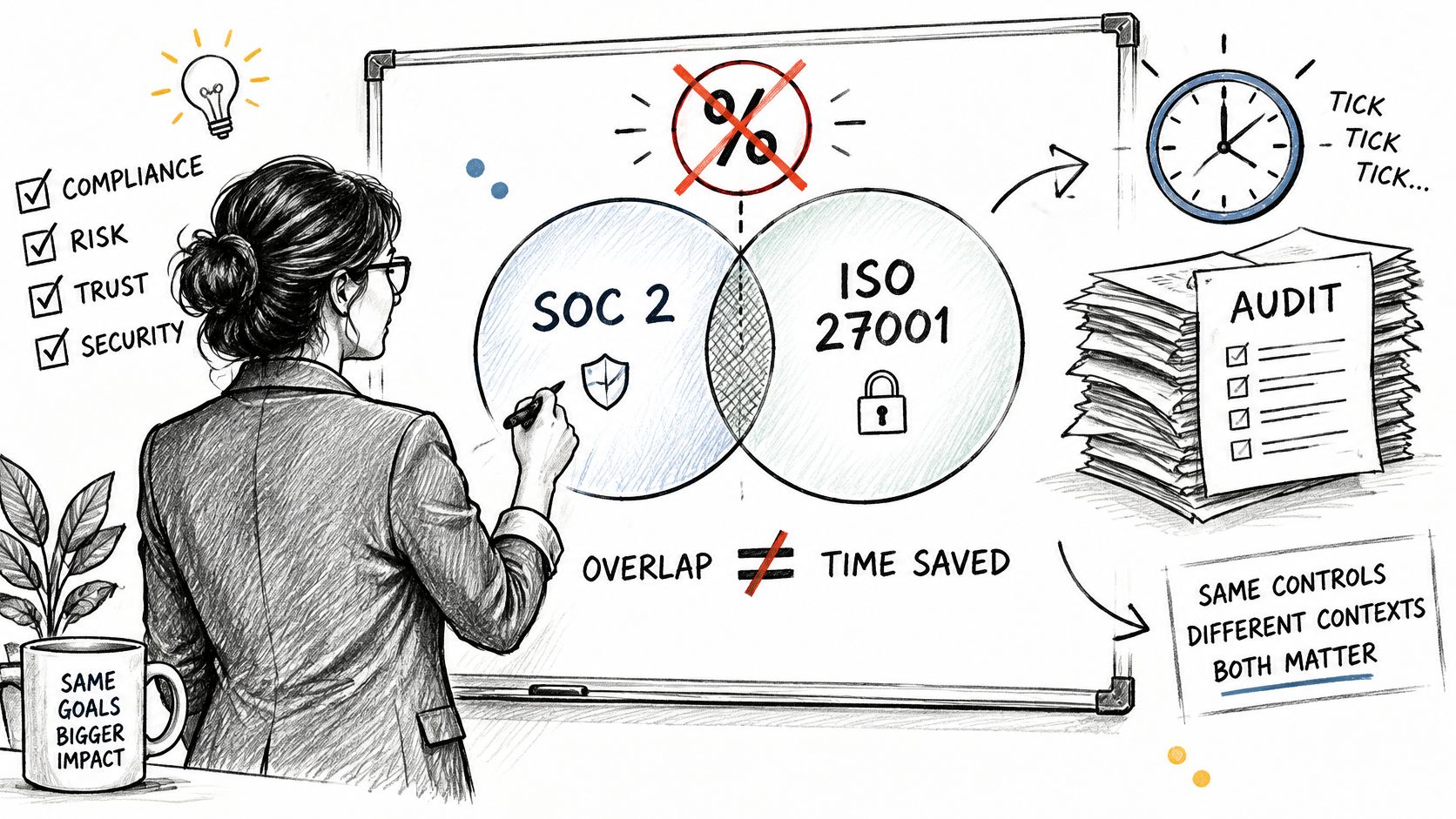
Shared implementation reduces duplicated engineering work. It doesn't eliminate assurance work. Budgeting from a headline overlap percentage confuses those activities.
A published crosswalk reports eight of 13 broad control domains mapping directly and five mapping partially, with no domain lacking an equivalent at that abstraction level. The AuditNex SOC 2 to ISO 27001 crosswalk also distinguishes shared safeguards from the different testing and management-system expectations. A broad relationship doesn't establish identical audit procedures.
Budget for the residual work
The engineering team might maintain a shared access-review workflow. The compliance team still needs to establish the relevant boundary, prepare appropriate evidence packages, resolve discrepancies, and explain exceptions. Someone must also perform and document the management-system activities already identified.
A useful planning distinction is:
- Implementation work: Building or changing the safeguard.
- Evidence work: Establishing completeness, provenance, and review context.
- Governance work: Making risk decisions and recording accountable oversight.
- Assurance work: Responding to examiner questions and resolving findings.
Consolidation can help with each category, but don't assume they shrink together. Automating evidence export won't decide whether a risk is acceptable. Linking a ticket won't establish that its approval was appropriate.
Budgeting test: Ask what work disappears, who stops doing it, and which remaining deliverable still needs an owner.
Keep separate estimates for control remediation and audit preparation. Otherwise, leadership may interpret a completed technical crosswalk as a nearly completed certification project.
The practical goal is less duplicate execution and clearer residual obligations. That's a defensible promise. Proportional savings based solely on mapped domains aren't.
Building a Unified Compliance Program
Build the program around work engineers can operate and reviewers can verify. Treat framework references as maintained metadata, not as the names of separate security programs.
Establish the operating model
Define the boundaries together. Put the SOC 2 system description and proposed ISMS scope beside an inventory of services, repositories, suppliers, and operational teams. Record differences explicitly. Don't resolve a scope mismatch by expanding an evidence label.
Write internal controls in operational language. Prefer “a designated reviewer approves changes to production agent permissions” over “comply with access-control requirements.” Specify the trigger, performer, reviewer, expected output, and exception route.
Assign decision rights. A platform engineer may maintain enforcement, while a security owner evaluates exceptions and an accountable manager accepts residual risk. Make those roles visible rather than assigning everything to a compliance mailbox.
| Program decision | Recommended output |
|---|---|
| Which systems are covered? | Approved scope and inventory relationship |
| Why is the control necessary? | Risk-treatment and applicability rationale |
| Who operates and reviews it? | Named ownership and escalation route |
| What demonstrates performance? | Evidence contract and retention decision |
| What happens when it fails? | Remediation or approved exception workflow |
Integrate evidence with engineering work
Connect GitHub pull requests, CI/CD checks, deployment records, and review tickets to internal control identifiers. Use stable references so an auditor can follow the chain without relying on a manually reconstructed narrative.
Keep mapping versions explicit. If you inherit an older ISO matrix, preserve its history while validating current references and evidence expectations. Don't overwrite previous relationships in a way that makes earlier conclusions impossible to reconstruct.
Use internal audits to test the chain itself: can a reviewer locate the source record, establish its scope, identify the decision-maker, and follow an unresolved issue? Bring recurring weaknesses into management review with named actions.
Finally, separate deterministic configuration findings from operational monitoring results. Track remediation against the relevant evidence class, then verify closure through the same workflow that produced the finding. The objective is a maintainable program, not an impressive folder assembled immediately before the audit.
Measuring Progress with an Implementation Scorecard
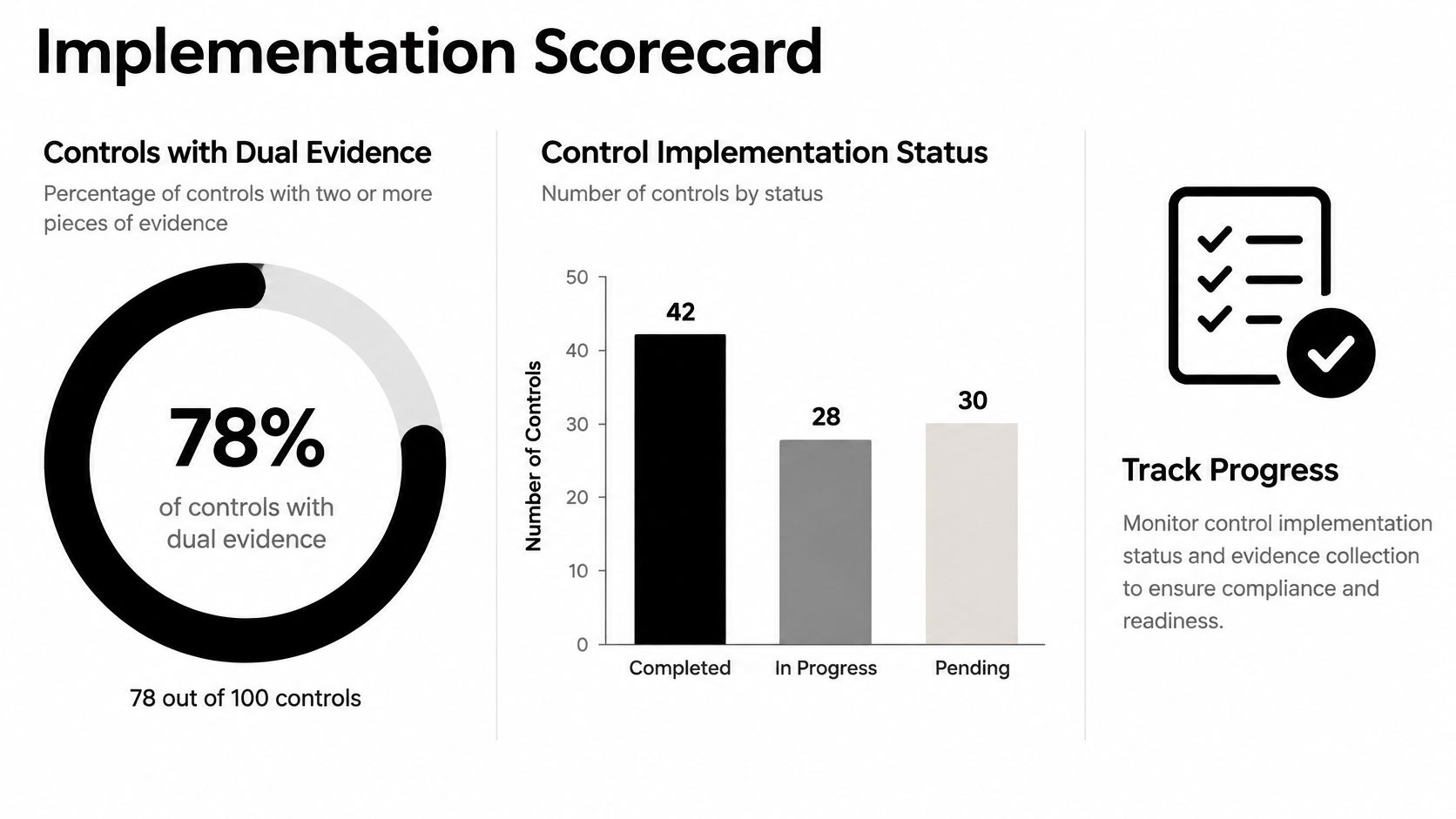
A mapping dashboard can look complete while the evidence remains unusable. Measure accepted reuse and unresolved gaps, not merely the presence of framework references.
Use the scorecard below as a design reference, not as a benchmark or a claim about your organization's readiness.
Define what each metric means
The implementation measures recommended by the crosswalk cited earlier include:
- Shared implementation: The proportion of in-scope controls operated through a common workflow.
- Reusable evidence: The proportion with records reviewed as suitable for both evidence packages.
- Framework-specific artifacts: The proportion still dependent on distinct deliverables.
- Evidence freshness and completeness: Whether records meet the control's cadence and relevant review period.
- Unresolved partial mappings: Relationships with an open scope, implementation, or evidence gap.
Define denominators before calculating anything. A control-level measure shouldn't become a document-level measure because uploading files makes the result look better.
Make residual gaps actionable
For each partial mapping, record the missing obligation, owner, next action, and acceptance condition. Distinguish “evidence not collected” from “control not implemented.” They require different responses.
Link automated findings to policy versions, configuration scope, remediation status, and retention decisions. Reviewers should be able to inspect why a scorecard entry changed, not just see its current color.
Present leadership with a paired view: what the team can reuse and what remains unproven. That makes progress visible without disguising governance work or allowing a large volume of low-value evidence to obscure an important unresolved requirement.
Frequently Asked Questions About Mapping
Can a shared implementation support both audits?
Yes, when its objective, scope, and execution support the relevant requirements. Keep the implementation shared, but validate the evidence package for each engagement. Don't require engineers to perform duplicate reviews merely because the audit labels differ.
What if an ISO requirement has no direct SOC 2 match?
Retain it as a distinct obligation within the unified program. Document why it applies, assign an owner, and identify the required evidence. Forcing an artificial SOC 2 relationship makes the matrix look tidier without improving coverage.
How should we handle different evidence requests?
Ask what assurance question each request addresses. Then provide a view of the preserved records with the necessary context. If the record lacks scope, provenance, or review information, fix that weakness rather than generating a differently formatted copy.
Does a completed mapping guarantee certification?
No. As established earlier, mapping organizes relationships; it doesn't replace independent examination or certification evaluation. Treat completion as readiness for validation, not approval of the underlying controls.
What should we do with an exception during the audit?
Preserve the original condition and its decision trail. Show who approved the exception, its boundaries, any compensating measures, and the remediation status. Don't replace the historical record with the corrected configuration and imply the earlier issue never existed.
Where should an engineering team begin?
Choose an existing workflow, such as agent-configuration approval, and trace it from proposed change through review, deployment, and exception handling. Validate that evidence chain before expanding the approach across the program.
Foo Guard provides deterministic pre-deployment scanning for AI agent configurations and MCP/tool definitions, plus versioned configuration history and Hosted Gateway monitoring and enforcement for supported routed requests. Visit Foo Guard to explore how configuration findings and runtime policy records can support your shared control evidence while keeping audit-specific governance obligations explicit.