What Is an MCP Gateway? Security for AI Agents
What Is an MCP Gateway. Learn what an MCP gateway is, how it enforces policy on AI agent tool calls, and why you need it alongside static scanners
An MCP gateway is a policy-enforcing intermediary between MCP clients and servers that authenticates callers, routes requests, and applies runtime controls such as allowlists and argument validation. It can govern live tool calls, but it can't prove that a server's tool descriptions are trustworthy or that an agent was safely configured before deployment.
That distinction challenges the most popular advice about MCP gateways. Routing and authentication matter, but agent security fails when teams confuse controlling a request with understanding the configuration and metadata behind that request. A gateway is valuable, but it isn't a substitute for pre-deployment analysis, least-privilege design, or disciplined review of MCP servers and agent definitions.
Why "MCP Gateway" Is Often the Wrong Question
The usual answer to “what is an MCP gateway?” sounds familiar: it's a reverse proxy that adds authentication, routing, rate limiting, and observability. Those capabilities are useful, especially when several clients need access to several remote MCP servers. But the reverse-proxy analogy becomes misleading when it implies that network control equals agent security.
An MCP gateway can inspect an MCP request closely enough to identify the method, destination tool, arguments, identity, and upstream server. It can allow, deny, log, or transform the request according to policy. It can also filter the tools exposed during discovery, which reduces unnecessary capability exposure before an agent chooses an operation. That semantic awareness is the important difference between an MCP gateway and a proxy that only sees HTTP paths and headers.
Practical rule: Treat the gateway as a runtime decision point, not as proof that the agent, server, or tool definition is safe.
The harder problem is what happens before a request reaches the gateway. A server may expose a tool whose description contains hidden instructions. An agent configuration may grant broad shell, filesystem, network, or database access. A credential may be present in a JSON or YAML definition even if the eventual request is authenticated correctly. The gateway can block a supported call, but it doesn't automatically explain whether the underlying capability should have been deployed at all.

Runtime control has a defined boundary
Tool poisoning makes that boundary concrete. Research examining adversarial variants of 353 real tools from 45 MCP servers across 20 language models reported an average tool-poisoning attack success rate of 36.5% (the MCPTox benchmark findings). A gateway may route the resulting call correctly and enforce an allowlist, yet it may not know that the tool metadata itself was manipulated.
That doesn't make gateways ineffective. It means their guarantee is narrower: they can govern traffic that passes through them, while static review and supply-chain controls must address what gets registered and deployed. Teams evaluating the right control should compare agent security controls by enforcement boundary, rather than asking which single product “secures MCP.”
A sound architecture therefore combines controls. Review configurations and tool definitions before release, route remote traffic through an enforceable gateway, version policies, and test whether local clients or IDE integrations can bypass the intended path. If the organization can't prove that every relevant execution path reaches the gateway, its audit record is incomplete by design.
How an MCP Gateway Works Under the Hood
An MCP gateway is easiest to understand as two connected planes. The control plane stores upstream server registrations, tool inventories, credential references, policy versions, and approved exceptions. The data plane handles live MCP traffic and evaluates each request against that state before forwarding it.
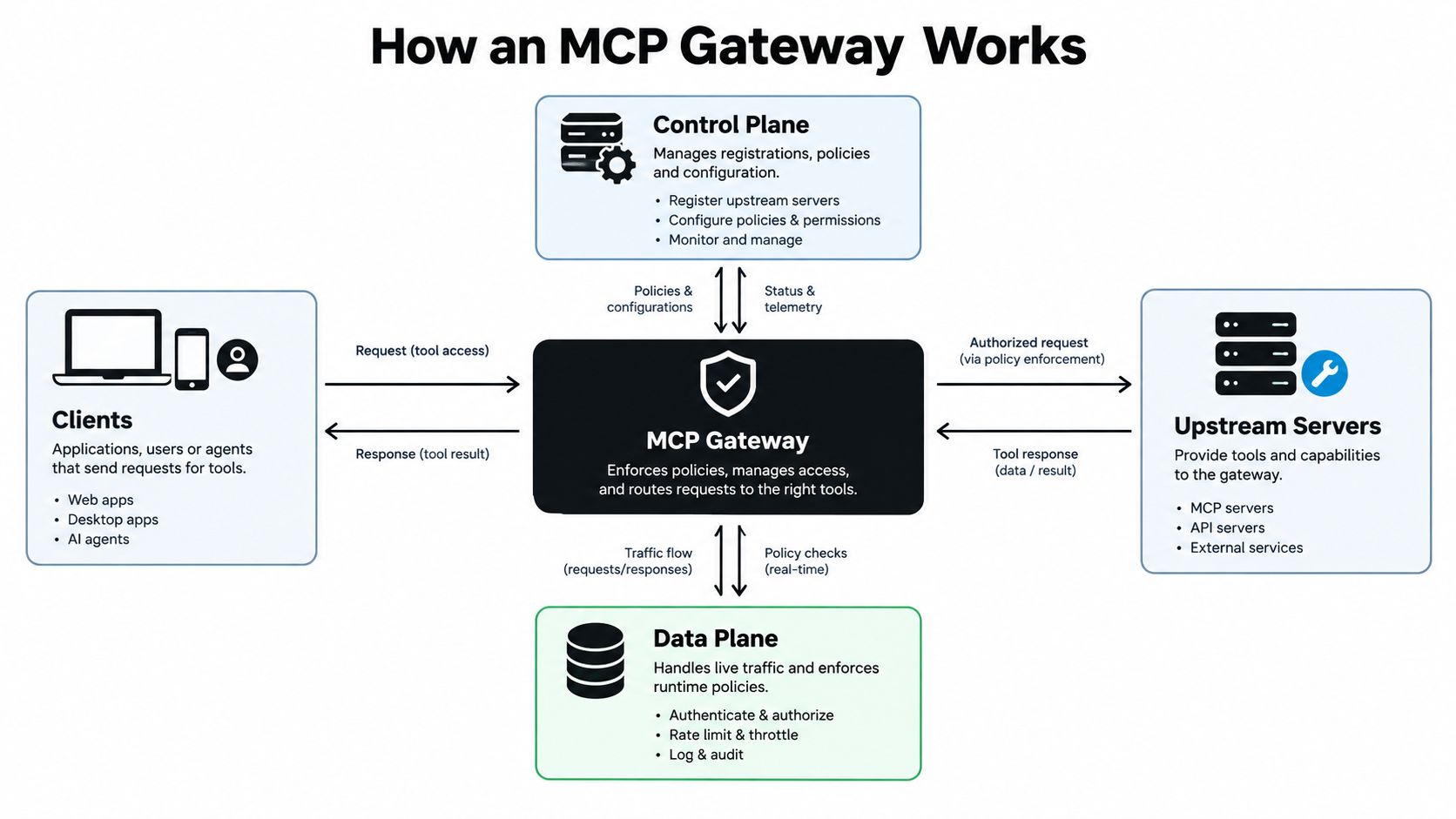
A remote request typically follows a controlled sequence:
- Ingress authentication identifies the calling client, user, tenant, or workload.
- Transport handling terminates or forwards Streamable HTTP traffic and selects the intended upstream server.
- Semantic authorization evaluates the MCP method, tool name, arguments, destination, and caller identity.
- Operational enforcement applies timeouts, rate limits, response limits, retry rules, and circuit-breaker behavior.
- Decision logging records the request, policy version, decision, upstream identity, and returned outcome.
The authorization model matters because a valid token isn't blanket permission. The MCP authorization specification describes the MCP server as an OAuth 2.1 resource server, the client as an OAuth client acting for a resource owner, and a separate authorization server as the issuer of access tokens. A gateway should validate the token issuer and audience, preserve tenant or user identity, and then make a separate decision about the specific operation.
Remote and local traffic don't have the same control surface
Gateways are most useful for remotely routed MCP traffic. The HTTP authorization flow isn't intended for local STDIO connections, where credentials commonly come from the execution environment. A developer launching an MCP server directly from an IDE can therefore create a path that never reaches the hosted gateway.
That difference should shape deployment decisions. Centralizing remote servers improves identity, auditability, upstream isolation, and policy consistency. It doesn't automatically govern every local process, copied configuration, or developer tool. A production design must inventory those paths and either route them through an approved control point or accept that they require separate endpoint and configuration controls.
The gateway's job is to authenticate at ingress, authorize the exact operation, forward only approved traffic, record the decision, and return the upstream result without exposing unnecessary credentials. That boundary is precise enough to be useful, but narrow enough that teams shouldn't mistake it for complete agent governance.
Static Scanners versus Runtime Gateways
Static analysis and runtime enforcement answer different operational questions. A scanner decides whether a configuration should be released. A gateway decides whether a live request should proceed.
A static scanner examines agent files and tool definitions before execution. It can identify excessive permissions, exposed credential material, risky shell or filesystem access, broad network reach, and unsafe autonomy settings. Its strongest advantage is timing: the team can reject or correct a dangerous configuration before an agent has an opportunity to use it.
A runtime gateway evaluates the request in context. It sees the caller, method, destination, tool, arguments, and applicable policy. It can deny unsupported operations, validate arguments, detect unexpected destinations or behavior, and record the decision for later investigation.
| Control | Best at catching | Main limitation |
|---|---|---|
| Static configuration analysis | Risky permissions, embedded secrets, unsafe autonomy, and policy drift before release | It does not observe live behavior or upstream responses |
| Runtime gateway enforcement | Unauthorized routed calls, malformed arguments, unexpected destinations, and operational abuse | It cannot govern local STDIO launches or unregistered servers that never route through it |
| Human and CI review | Context, intended use, ownership, and exceptions | Review quality depends on evidence and consistent policy |
These controls work at different stages. A scanner can flag a tool definition requesting broad access, while the gateway restricts the live calls that pass release review. A gateway can block a dangerous argument pattern at runtime, while static analysis can find an unsafe default in the agent configuration before any request reaches the gateway.
The scanner protects the release decision. The gateway protects the execution path.
Foo Guard presents this separation through a configuration security scanner for JSON and YAML agent definitions using deterministic rules, alongside a Hosted Gateway that provides monitoring, auditing, allowlists, argument validation, and blocking for supported MCP tool calls (Foo Guard's product overview). The product details matter less than the control boundary: pre-deployment analysis evaluates what teams are about to run, while the gateway governs traffic that crosses its enforcement point.
A clean static result is not permanent approval. Configurations change, tool inventories drift, policies weaken, and new upstream servers appear. A practical workflow scans pull requests and published versions, then uses the gateway to enforce the approved runtime boundary. Connect the release record to the request record so an auditor or incident responder can explain why a call was allowed.
For a deeper examination of pre-deployment controls, read this analysis of static AI agent security. The operational choice is not static analysis or a gateway. Both phases need an accountable control, and each must be tested against the paths agents can use.
The Protocol Semantics That Enable Gateway Enforcement
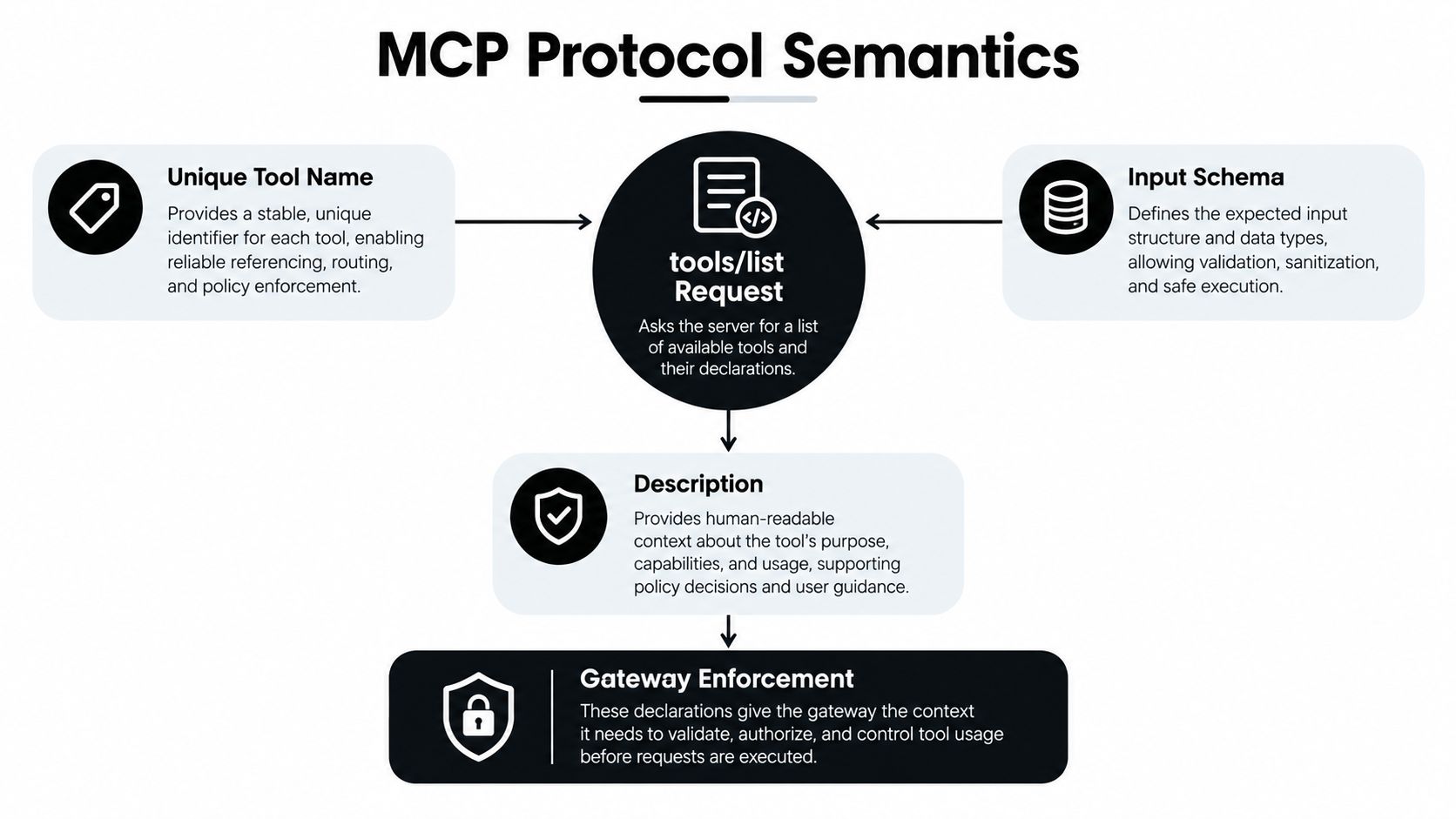
An MCP gateway can enforce precise policy because MCP gives it structured events to inspect. Tool-capable servers declare the tools capability and respond to a tools/list request with the tools available to the client. Each tool has a unique name, descriptive metadata, and an inputSchema expressed with JSON Schema. An optional outputSchema describes the expected result.
The client then sends a tools/call request containing the selected tool name and arguments. Protocol messages follow JSON-RPC 2.0, which gives the gateway a standardized message format and lifecycle rather than an opaque stream of agent-generated text. These requirements are defined in the MCP tools specification.
Discovery is part of the security boundary
A gateway can mediate discovery as well as execution. Instead of returning every upstream tool to every client, it can filter the inventory according to identity, tenant, environment, or role. A finance workflow might receive read-only reporting tools, while an engineering workflow receives a different set. Reducing exposure doesn't prove that a tool is safe, but it limits what an agent can select and what developers must reason about.
At call time, the gateway can combine several policy dimensions:
- Method and tool name, so a policy distinguishes discovery from execution and separates one operation from another.
- Argument schema, so required fields, types, ranges, and permitted values are checked before forwarding.
- Identity and tenant, so the same tool isn't automatically available to every user or agent.
- Destination, so a call can't move unnoticed from an approved upstream server to an unapproved one.
- Decision history, so the organization can reconstruct which policy version allowed or denied the operation.
This is semantic routing, not merely URL routing. A network proxy might identify an HTTP request, but it won't necessarily understand that tools/call targets a destructive tool with a credential-bearing argument. MCP's structured names and schemas create the inspection surface needed for that distinction.
The semantic layer still has a trust problem. The gateway can read a tool's name, description, and schema, but those declarations may be incomplete, misleading, or changed after review. That is why discovery filtering and argument validation should sit alongside version pinning, static inspection, and ownership checks. Structured metadata enables enforcement, but structure alone doesn't establish honesty.
Teams implementing routing logic can use a documented gateway model for MCP routing as a reference point, while keeping policy decisions specific to their own tools and risk tolerance.
Implementing Gateway Policies That Actually Work
Start with the execution path, not the policy file. Identify every MCP client, remote server, IDE integration, local STDIO process, and alternate endpoint that can perform an agent action. A policy is only meaningful when the organization knows which traffic it covers and where requests can bypass it.
Build decisions from identity to arguments
Authenticate at ingress and preserve the caller's identity through the upstream request. Validate issuer and audience, then authorize the actual operation. Don't grant every tool merely because the token is valid.
A practical policy sequence looks like this:
- Register approved upstreams. Give each server an owner, environment, credential reference, and reviewed tool inventory.
- Expose the minimum discovery set. Filter
tools/listresults so clients receive only capabilities appropriate to their identity and workflow. - Allowlist specific operations. Start with named tools and methods, especially for write, delete, administrative, or credential-bearing actions.
- Validate arguments. Enforce the declared schema and add business constraints where the schema is too broad. A syntactically valid identifier may still point to the wrong tenant or environment.
- Default sensitive actions to denial. Require an explicit exception or approval path for destructive operations instead of relying on a broad server-level allowlist.
- Log every decision. Record identity, tool, destination, arguments subject to safe redaction, policy version, result, and denial reason.
A valid token answers who is calling. It doesn't answer whether this tool call is authorized.
Operational controls keep the gateway from becoming a failure multiplier. Set bounded timeouts, response-size limits, retry controls, and circuit breakers. Without them, a slow or failing upstream can consume client resources, repeated retries can amplify an incident, and oversized responses can create a separate availability or data-handling problem.
Test the choke point
A centralized gateway creates a useful enforcement point, but it also creates a dependency that deserves adversarial testing. Verify that blocked requests remain blocked during upstream errors, policy reloads, authentication failures, and partial outages. Test whether a client can connect directly to a server, whether a local launch bypasses the gateway, and whether an alternate hostname or transport escapes monitoring.
Policy changes should be versioned and reviewed like code. Keep exceptions explicit, time-bounded where possible, and tied to an owner. Explain denials to developers with enough context to fix the request without revealing sensitive policy details. A system that blocks correctly but produces incomprehensible errors will encourage workarounds, which is how bypass paths become permanent.
The Risks Gateways Cannot Prevent
A gateway can control a request without proving that the request was shaped by trustworthy tool metadata. MCP does not provide cryptographic attestation for tool descriptions, and clients lack a protocol-level way to confirm that live definitions still match the versions reviewed earlier. Hidden instructions in metadata may influence an agent before the gateway sees the resulting call.
Tool poisoning exposes this boundary. A gateway can restrict the invocation that follows, but it cannot reliably determine whether a description was written to manipulate the model or whether a trusted server changed its behavior. That judgment requires inspection before deployment, not only filtering at runtime.
A gateway also cannot repair weak deployment hygiene. It cannot identify excessive agent authority, remove credentials from a flawed configuration, or correct a permissive CI rule unless separate controls enforce those decisions. For example, a reviewed tool inventory in the Library may be replaced by an unreviewed upstream version two commits later. The gateway can enforce its current runtime policy while missing the change in provenance.
Local processes, unregistered servers, policy drift, and compromised upstream software can remain outside the gateway's coverage. A direct connection or local launch may bypass the controls entirely.
Use layered controls: inspect configurations and tool definitions before deployment, publish reviewed versions, enforce identity and operation-level policy at runtime, and audit approved and bypassed execution paths. A gateway reduces runtime exposure. Static analysis helps establish what should be exposed before the agent reaches production.