GitHub Actions Security: A Practical Hardening Guide
Harden GitHub Actions security with practical safeguards for secrets, scopes, workflows, and CI scanning. Reduce blast radius and supply-chain risk.
A contributor opens a pull request from a fork. The checks look familiar: checkout, install dependencies, run tests, publish a preview. Somewhere in that workflow sits a third-party action nobody has reviewed since it was added, alongside a token whose permissions were copied from the release pipeline. Before approving the run, you need to know what that combination can reach.
Why GitHub Actions Security Is the New Perimeter
A deployment workflow isn't just build automation. Depending on its configuration, it can modify repository content, publish packages, request cloud credentials, and influence what reaches production. GitHub's guidance on secure use of Actions treats workflow code, external actions, and their authorization as security-sensitive dependencies.
The practical mistake is reviewing those pieces separately. A platform engineer approves an action, a cloud engineer configures federation, and a repository administrator sets workflow permissions. Each decision might look reasonable in isolation while the assembled workflow gives untrusted code a route to deployment authority.
Follow the authority, not just the YAML
Consider a preview pipeline as a hypothetical design review. Running contributor tests is one operation; publishing a preview with credentials is another. Putting both into the same privileged execution context deserves more scrutiny than either task alone.
Ask what changes when an attacker controls an input:
- Execution: Can contributor-controlled code or configuration influence a command?
- Authorization: What repository operations or deployment capabilities are available where that command runs?
- Output: Could the job publish something another, more trusted job will consume?
These questions connect least privilege, dependency integrity, and pre-deployment review. A control changes outcomes when it interrupts a specific path from untrusted input to privileged execution.
Practical rule: Review a workflow as an authorization path, not merely as a sequence of successful steps.
That approach also makes hardening less disruptive. You don't need to impose deployment-grade approval on every formatting check. You need to identify where trust increases, then make that transition explicit and reviewable.
For a platform team deploying agents, the boundary includes both the pipeline and the configuration it ships. A tightly controlled release process can still deploy an agent with unnecessarily powerful tools. Conversely, a carefully restricted agent definition doesn't protect an overprivileged release job.
The GitHub Actions Attack Surface Explained
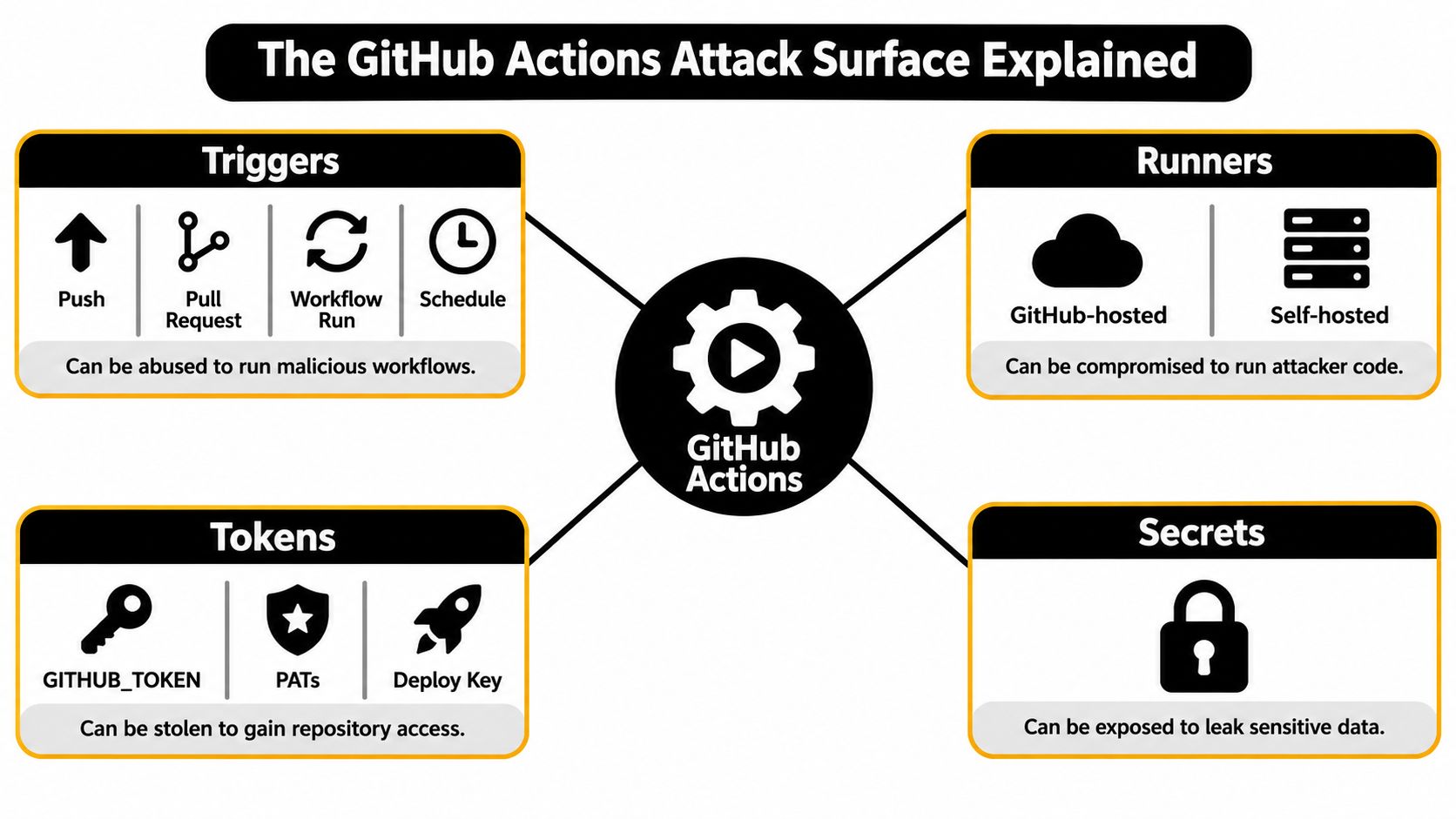
Start with a shared map of what can start execution, where execution happens, and what authority accompanies it. The following diagram groups the core workflow primitives.
Identify the execution path
Use these distinctions when reviewing a proposed pipeline, rather than treating every workflow as equivalent:
- Triggers are entry points. Inspect
push,pull_request,workflow_run, andscheduleas different reasons execution begins. Think of them as doors with different admission rules, not interchangeable event names. - Runners are execution rooms. Distinguish GitHub-hosted execution from self-hosted infrastructure your team manages. For either design, document what the job should be able to reach and what must remain isolated.
- Tokens are authorization badges. Inventory
GITHUB_TOKEN, personal access tokens, and deploy keys separately. Record the resource each credential authorizes instead of labeling everything “CI access.” - Secrets are protected inputs. Treat each credential supplied to a job as something that job's executable dependencies must be trusted to handle.
Two less-visible elements belong on that map: artifacts, which carry outputs between stages, and third-party actions, which introduce executable dependencies. Treat artifacts like deliveries crossing a boundary and actions like programs you're admitting into the execution room.
Record trust alongside functionality
For each job, write down its input origin, executable dependencies, credentials, and output consumers. This inventory should explain why a job needs authority, not just confirm that its YAML parses.
The same distinction matters in broader application security: a recognizable vulnerability category is useful only when you can locate the affected boundary. A review of the OWASP Top 10 can help teams establish that vocabulary without replacing a workflow-specific threat model.
Don't assume a downstream stage can trust an output because another workflow produced it. Make the producing context part of the review. Most useful hardening work tightens one of these relationships rather than adding an unrelated security toggle.
Excessive Permissions and the GITHUB_TOKEN Problem
Start a permissions review with the release workflow, then work backward toward contributor-facing jobs. Look for missing declarations, broad write access, and copied permission blocks that no longer match what the job does. GitHub's workflow-hardening guidance provides relevant context for reviewing authorization before deployment.
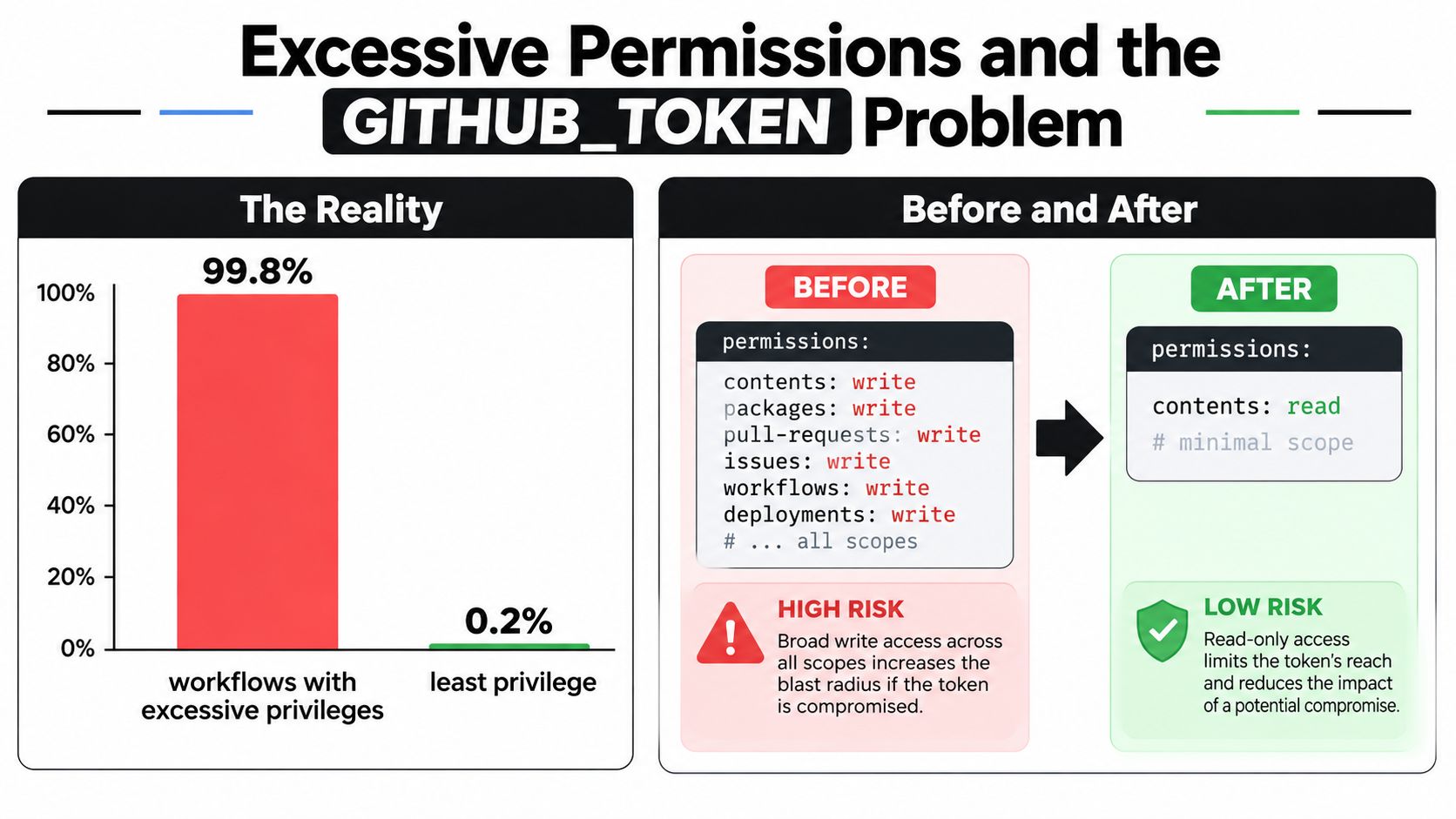
The following visual highlights the distinction between broad workflow authority and narrowly scoped access.
Replace inherited assumptions with explicit intent
Don't infer permissions from whether a repository is public. Inspect its effective settings and make the workflow's intended authorization explicit. Likewise, read-all isn't the same as least privilege: it expresses broad read access rather than identifying the particular resource a job needs.
A concrete before-and-after review can stay small:
| Configuration point | Before | Proposed hardening |
|---|---|---|
| Workflow baseline | permissions: write-all | permissions: {} |
| Source-reading job | Inherits broad authority | Declare contents: read |
| Package publisher | Shares the same baseline | Grant required package access only in its job |
| Deployment job | Carries unrelated write scopes | Declare only its justified deployment permissions |
This is a design example, not a complete workflow. Validate the exact permissions against the operations your jobs perform before merging it.
Scope authority by operation
Permission names should correspond to a documented need. Repository content access, package publication, and deployment operations are different capabilities; a test job shouldn't receive all of them because a later release job needs one.
Use job separation to make that distinction visible. If a job both processes untrusted input and publishes a release, splitting it creates an opportunity to review the handoff rather than granting the entire sequence publication authority.
A compromised dependency doesn't need every permission. It needs whichever permission makes the next step possible.
The operational trade-off is maintenance. Explicit permissions can reveal undocumented dependencies when a workflow stops working. Fix that by identifying the failed operation and granting its narrow requirement, not by restoring write-all until the checks turn green.
Treat permission changes as security changes during review. A request for new write access should explain the operation, the affected resource, and why the work can't remain in a less-privileged job.
Secrets Hygiene and OIDC Federation
A long-lived cloud credential stored as a secret creates a recovery obligation: if someone obtains it, it can remain usable until it's revoked or rotated. OpenID Connect federation changes that authentication model by allowing a job to exchange a GitHub-issued identity token for short-lived cloud access, as described in GitHub's cloud-provider OIDC guidance.
That doesn't make credential handling irrelevant. It changes which credential you protect, how long the resulting access persists, and where authorization is enforced. Prefer federation where supported, but review the trust relationship before deleting the old secret.
Separate identity from authorization
The workflow permission id-token: write permits requesting a GitHub-issued OIDC token. It doesn't itself authorize cloud-resource modification. The cloud provider evaluates the token's claims and applies the configured trust policy and role permissions.
GitHub's OIDC security model makes that division important: federation doesn't automatically deliver least privilege. A restrictive workflow permission block can't compensate for a cloud role that trusts unrelated execution contexts.
Review the relationship through concrete questions:
- Repository identity: Which repository or organization may assume the role?
- Deployment context: Which branch, tag, environment, or workflow identity should qualify?
- Event context: Could an unintended execution path satisfy the conditions?
- Role authority: Which cloud operations remain possible after authentication succeeds?
Define conditions using claims supported by the provider and verify that their combined behavior matches your intended deployment path. Broad matches deserve the same scrutiny as broad token permissions.
Keep residual secrets deliberately boring
Some integrations will still need static credentials. For those, keep an inventory of purpose, owner, consuming job, permitted operations, and revocation procedure. Supply only the credential the operation needs instead of handing a job a general collection of secrets.
Don't turn rotation into a substitute for scoping. A frequently replaced credential can still be dangerous while valid, and an incident becomes harder to contain when nobody knows which workflows consume it.
A practical migration starts with a deployment path whose owner can test both successful and denied authentication. Confirm that the intended workflow gets access and that an unintended context doesn't, then retire the obsolete secret. The result should be a narrower, understandable trust relationship, not merely a different login mechanism.
Supply-Chain Risks and SHA Pinning in Practice
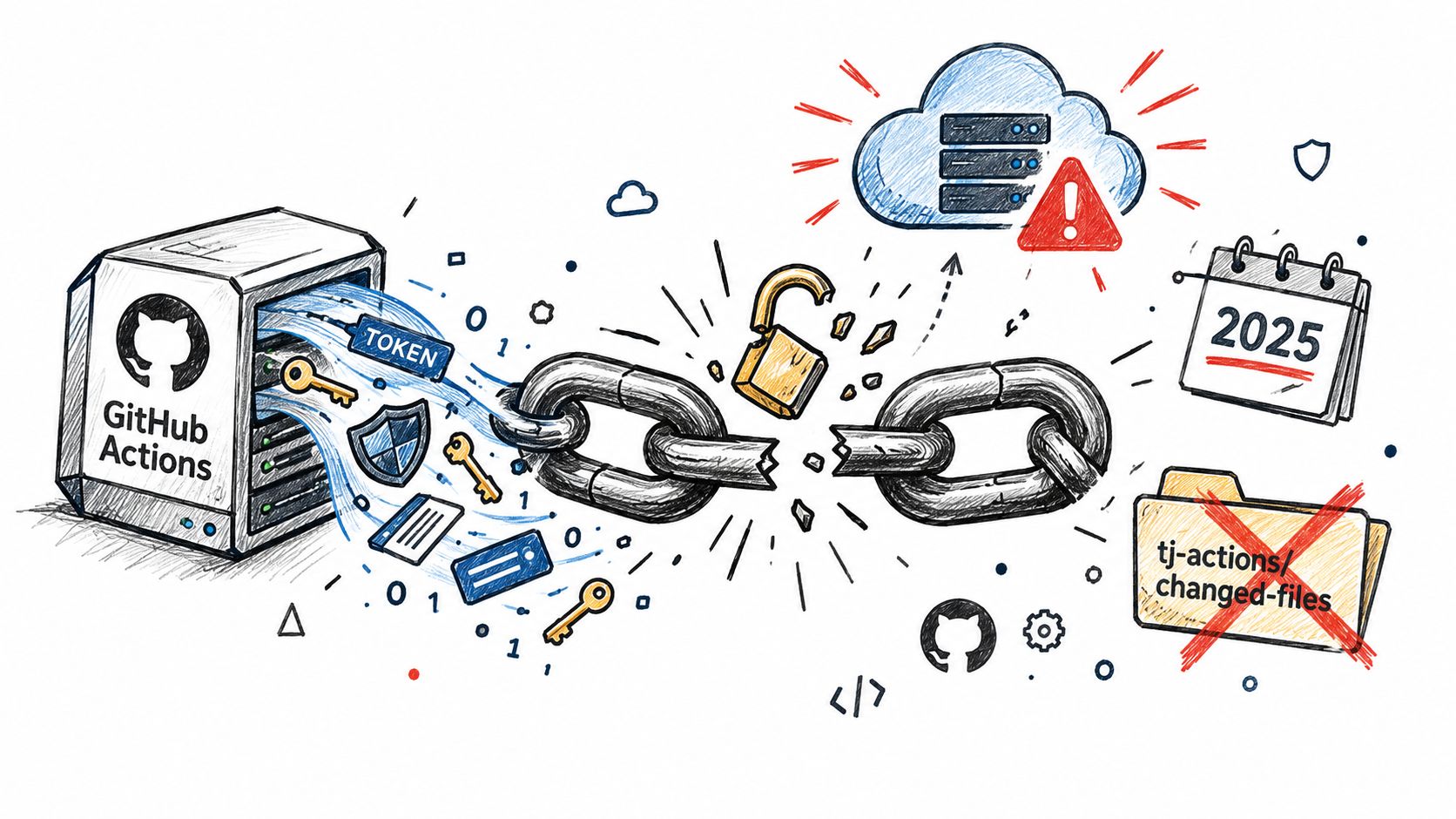
In 2025, the tj-actions/changed-files compromise reportedly exposed runner memory containing cloud keys, GitHub tokens, package-manager tokens, and private keys across an estimated 23,000 repositories, according to the GitHub Actions supply-chain risk report. The reported path ran through a second compromised action and mutable version references, so the code executing in the runner no longer matched the code anyone had reviewed.
One upstream change, thousands of pipelines.
That is the shape of supply-chain risk in Actions. Permissions, secret scope, and deployment gates all assume the workflow file describes what will run. A mutable reference breaks that assumption at every layer at once.
Pin the commit, then keep it current
A tag like v3 can point somewhere new tomorrow, even when it looks like a fixed version. A full-length commit SHA identifies a specific Git object, the immutable reference mechanism described in GitHub's secure-use guidance. Pinning is not a one-time edit, though. Without an update process, teams trade mutable dependencies for dependencies nobody dares to touch.
Treat each update as a small review:
- Resolve the new reference to its commit and confirm it belongs to the upstream repository, not an unexpected fork or lookalike.
- Read the diff between the pinned commit and the proposed one, rather than approving a bare SHA replacement.
- Trace transitive execution: does the action invoke other actions, download scripts, or resolve packages at runtime?
That third step exposes pinning's limits. A pinned action can already contain malicious behavior at review time, and it can fetch mutable dependencies after the run starts. Pinning establishes which action code you selected; it says nothing about everything that code might do. The controls compound when the surface is treated as one system: a pinned action running under a least-privilege GITHUB_TOKEN and a narrowly scoped OIDC role has far less to reach than the same action under a broad token, and deterministic review of the workflow file catches unpinned or newly added references before they merge.
For additional context alongside a code-level dependency review, use the accompanying video.
When a dependency turns, speed is a records problem
After an incident, "we use that action" answers nothing. The questions that matter are which commits ran, in which execution contexts, with which credentials, and what they published.
The inventory that answers those questions looks like this:
| Record | What it tells you during an incident |
|---|---|
| Action references mapped to jobs and environments | Where the dependency actually executes |
| Secret usage and assumed cloud roles per job | Which credentials need revocation |
| The revision each relevant run resolved | Whether you ran the bad commit or a clean one |
| Artifact and release consumers | Which outputs need quarantine or investigation |
Static inventory establishes scope; it does not prove what happened inside a runner. Keep named owners for revocation, output quarantine, and release investigation, and rehearse blocking a dependency before you need to.
Incident-readiness test: Can your team identify which credentials and release outputs need investigation without reconstructing the pipeline from memory?
Workflow Protections and Approval Gates
A contributor's pull request fails an integration check, gets fixed, and merges without incident. A week later a maintainer edits the deploy workflow to grant a job id-token: write and adds an action referenced only by major version tag. Every check passes. Nobody reviews the workflow file itself, because nothing flagged it as sensitive. The second change was the dangerous one.
That asymmetry is what approval gates exist to correct. Routine contributor checks deserve a fast path; changes to the execution path itself deserve a named human who signed off.
Treat .github/workflows/ as executable infrastructure with designated ownership. Enforce owner review through repository protections, and surface permission changes in the diff so a reviewer sees GITHUB_TOKEN scope expansion without hunting for it. Encode the repeatable requirements, such as allowed event triggers, required permission declarations, and self-hosted runner restrictions on untrusted input, using policy-as-code examples rather than expecting a reviewer to recall each rule under time pressure.
Where the reviewer earns their keep
Human judgment belongs at three trust transitions: first-time contributor execution, workflow modification, and deployment authorization. For unfamiliar contributors, configure approval requirements and know what approval permits their code to run. For deployments, environment protection rules with required reviewers and waiting periods put a named person between a workflow and production.
Verify the approved revision is the one that executes. A stale approval rubber-stamps code the reviewer never saw. And keep environment-scoped secrets inside the corresponding boundary. If an unrelated job can reach the same credential, the environment approval is decoration.
Pull request handling with elevated triggers
pull_request_target exists for privileged metadata operations on untrusted code, such as labeling or comment automation. It runs in the base repository's context, which is exactly why it must never check out and execute the contributor's revision. Split the work: privileged workflow handles metadata with an explicit allowlist of accepted inputs, ordinary pull_request checks run the untrusted code with narrow permissions and no deployment credentials.
Trace the consumers too. A contributor-generated check output becomes security-relevant the moment a privileged workflow parses it as an instruction or trusted artifact.
Hold the line on selectivity. Teams that hit an approval wall on every change learn to route around it, and a gate that exists on paper but gets bypassed in practice controls nothing.
CI Integration With Pre-Deployment Scanners
A pull request lands carrying two changes: a new shell tool enabled in an agent's tool definition, and an edit to the workflow that deploys it. One diff, two different classes of risk, and no single scanner that will evaluate both.
That is the case for treating pre-deployment review as deterministic, pipeline-enforced analysis rather than a checklist item. A workflow-security analyzer reads the workflow configuration: trigger conditions, declared permissions, action references. An agent-configuration scanner reads declared tools, credentials, and approval settings. Both inputs happen to be YAML, which tells you nothing about whether one tool covers both formats. Verify support before assuming coverage.
Wiring this into CI is mostly scoping work. Require checks on changes to .github/workflows/, agent definitions, and tool specifications, then keep the reviewing workflow itself minimally privileged so it cannot become the escalation path it exists to catch. Where the scanner exposes policy controls, apply organization-set minGrade and failOn thresholds instead of letting each repository soften them. Findings should attach to the commit with the affected location, the violated rule, and a proposed fix, so a reviewer sees the unpinned action reference and the ungated shell tool as two separate pieces of evidence rather than one unexplained score.
Two failure modes deserve attention. Baseline comparisons first: without them, every run surfaces pre-existing findings alongside newly introduced exposure, and reviewers learn to ignore the output. Then self-modification: a pull request that edits the check configuration must not weaken the gate judging it. Keep policy definitions outside the contributor's diff or behind code-owner review.
What each layer covers
| Control | Lifecycle stage | What it does not cover |
|---|---|---|
| Workflow static review | Before merge | Actual behavior inside the runner |
| Agent configuration review | Before agent deployment | Live tool-call behavior |
| SHA pinning | Dependency selection | Malicious code already selected |
| OIDC trust and role policy | Job authentication | Whether deployed configuration is safe |
| Deployment approval | Protected release transition | Every subsequent runtime operation |
| Runtime gateway | Supported routed requests | Traffic that bypasses the gateway |
For agent workloads, MCP security best practices extend this model past merge time. Static analysis covers the committed configuration. Live tool calls sit outside its reach, and a runtime gateway governs only the traffic routed through it, which is why the layers above complement rather than substitute for each other.
A Prioritized Hardening Checklist
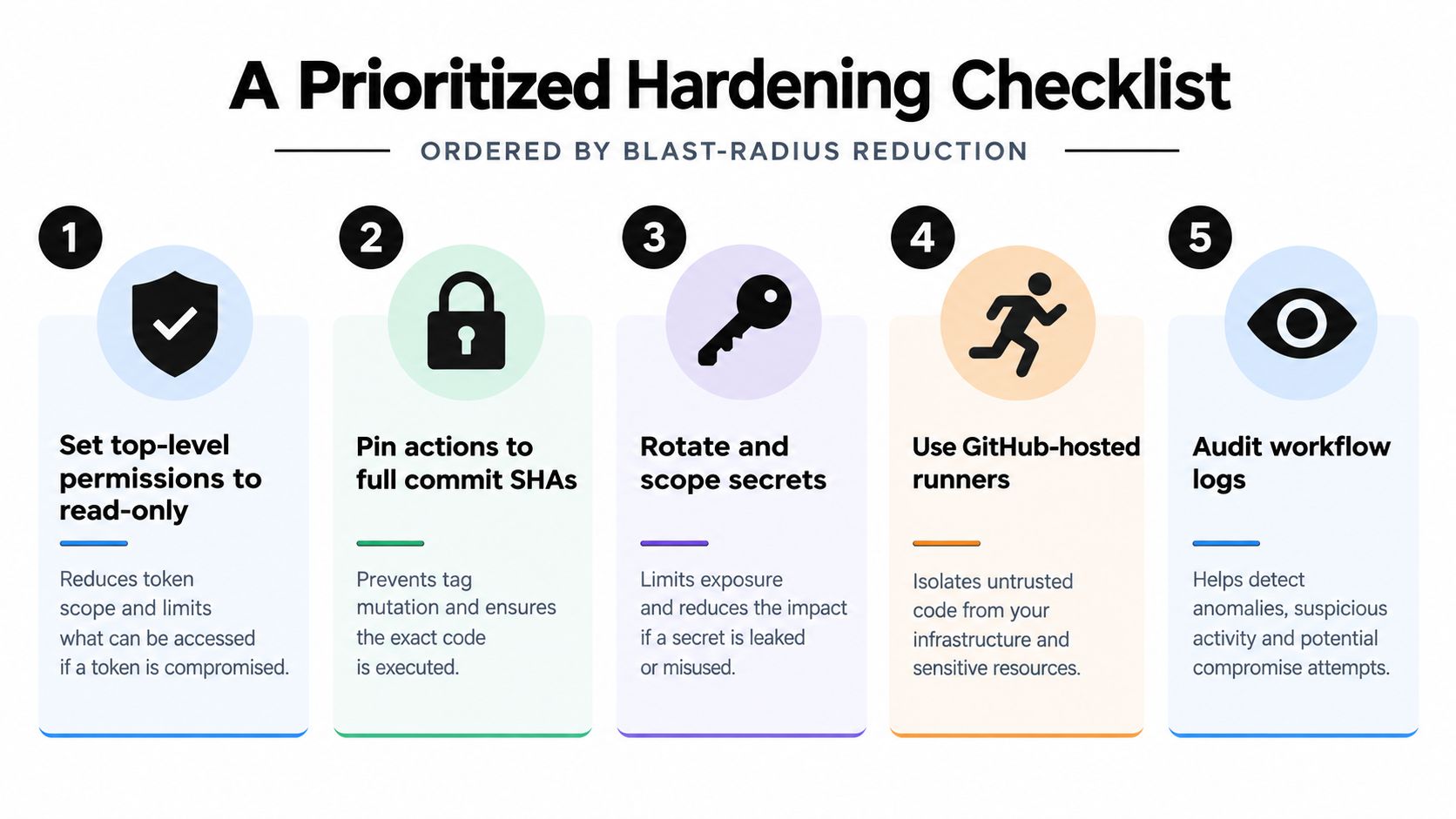
Prioritize changes by the authority they remove, then expand coverage. Use this visual as a quick operational reminder alongside the deployment-focused priorities below.
Start with the release path
- Reduce token authority. Set a restrictive workflow baseline and justify job-level exceptions. Start with jobs that execute external code or can affect releases.
- Narrow cloud access. Migrate an owned deployment path to OIDC with restrictive claims and role permissions. Remove the replaced credential.
- Make dependencies reviewable. Pin third-party actions to verified upstream commits. Assign responsibility for reviewing updates and transitive execution.
- Protect trust transitions. Require workflow-owner review and deployment approval where authority increases. Keep contributor checks outside privileged execution paths.
- Enforce configuration policy. Add required pre-deployment checks with evidence-backed findings. Establish who can approve exceptions and how those decisions are recorded.
GitHub Actions security is layered, but the layers aren't interchangeable. If you temporarily relax a control, document the resulting exposure and the compensating boundary instead of assuming another feature covers it.
Foo Guard provides deterministic pre-deployment review for AI agent configurations and MCP/tool definitions, with evidence-backed findings and policy thresholds for GitHub and CI checks. Visit Foo Guard to add configuration review to your release pipeline and keep agent-policy decisions separate from workflow and runtime controls.